
Liturgy, Reflection and muse.
Elendil Voronda

The Last Alliance of Men and Elves.
Showing posts with label Church. Show all posts
Showing posts with label Church. Show all posts
Friday, 20 July 2012
Rev John Wesley
"I do not wonder the Gospel runs so swiftly in these parts. The people in general have the finest natural tempers which I ever knew; they have the softness and courtesy of the Irish, the seriousness of theScots and the openness of the English" - John Wesley, from The Journal of the Rev John Wesley, April 1767

Wednesday, 18 July 2012
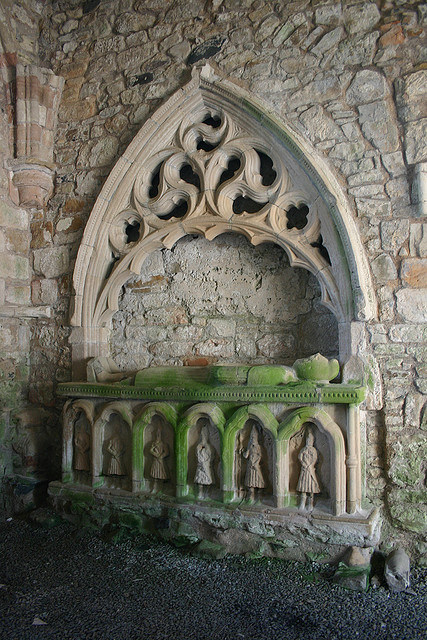
Dungiven Priory
Today I visited an interesting site in the town of Dungiven County Derry. The site contains what is believed to be an 11th Century Augustinian priory. It contains the tomb of O'Cahan (Cooey na Gall O' Cahan), laid to rest in 1385. A thicket of thorn bushes hung with rags conceals a bullaun stone, visited for wart cures.


Tuesday, 17 July 2012
A Trip To Knock The National Shrine

Last Friday during a sojourn in the pleasant County of Mayo I visited the National Shrine of Ireland in the little village of Knock. It was a most interesting experience not in a spiritual sense but in a social and cultural sense. I also attended Mass at the Shrine which was a most empty experience.
The little village itself is flooded with Catholic gift shops of the most extreme kind. Plastic statues of the Saints and Our Lady, and all sorts of cheap and nasty items. I did purchase a knock medal as a memento of the visit.
The Mass was awful, it must have lasted twenty minutes at most and it was conducted by a Priest who clearly had no interest in what he was doing. Imagine if you will during a Church service that a Priest continually says "whatever" while praying. For example "We pray for the members of the Cork MS Society and whatever". It was incredibly empty. The Priest also said something that rocked the very fibres of my theological intellect. He exclaimed that if anyone had bought a Holy Picture, Rosaries, Statues, Holy water etc that they should hold them up now to be blessed. The items he said did not have to be taken out of their plastic bags for if it was your intention that they should be blessed then they would indeed be blessed. From that moment on those items would bestow graces to all who used them. How awful. Also during the Mass there was the odd impromptu singing of a Marian Hymn, it started as wail and lead me to think that someone was having a fit.
I have to say that it was not nice at all. It give me an experience of how the Roman system can be so very empty and lacking in theology. It also lead me to question the circumstances of the alleged visit of the Blessed Virgin Mary. The social and historical context of rural Ireland at the time of the vision are more interesting than the vision itself. It was tumultuous period in Irish History, at least twenty years after the famine and apparently there had been a bad harvest prior to the vision that brought about fears of a second famine. So it seems to me that Irish Catholics needed some sort of sign and seal of their faith to help them through their lives in an ever changing society. I do not doubt the credibility of the witnesses I am sure that they were all very sincere people, but I can't help but think that there is more to this than meets the eye. When we compare it with Fatima and Lourdes there are striking similarities with the social and cultural backgrounds surrounding the vision. It would provide for an interesting discussion.
I have never really been in tune with the extreme Marian devotion in Ireland and I know many Roman Catholics who don't bother with it. I can't help but feel that there is something amiss when a Priest says " all our intentions we ask to Mary through Jesus Christ Our Lord". To me that simply does not make sense when you think about it. Why ask Mary through Christ? We are told that no one comes to Father except through the Son. Anyway moving on....
The Basilica at Knock is horrid except for the Stations of the Cross inside which are quite beautiful. One noted the vomit inside that had not been cleaned up, which to me summed up the whole affair. The Old Parish Church has been changed inside ever so slightly and I did not like it either.
It is worth a visit and you can make a judgement on what you see yourself.
Monday, 18 June 2012
St Mary's Episcopal Church, Dunblane
St Mary's Episcopal Church is a medium-sized church in Dunblane, Scotland. It is situated by the Fourways roundabout.
The current rector is the Rev. Kimberly Bohan, who succeeded Canon Janice Cameron and the Rev. Gianfranco Tellini.
The church grounds consists of a graveyard, the manse, a medium-sized church hall with kitchen and committee room, and a meditation walk designed by Canon Cameron.


Dunblane Cathedral
Dunblane Cathedral is the larger of the two Church of Scotland parish churches serving Dunblane, near the city of Stirling, in central Scotland.
The lowest section of the tower is Romanesque from the 12th century, and most of the rest of the building is Gothic, from the 13th century. The building was restored by Rowand Anderson in 1889-93.
The Cathedral was once the seat of the bishops of Dunblane (also sometimes called 'of Strathearn'), until the abolition of bishops after the Scottish Reformation. There are remains of the vaults of the episcopal palace to the south of the cathedral. Technically, it is no longer a cathedral, as there are no bishops in the Church of Scotland, which is a Presbyterian denomination.
William Chisholme, the last Catholic bishop of Dunblane in 1561, later became bishop of Vaison in France.
It contains the graves of Margaret Drummond of Stobhall, a mistress of King James IV of Scotland and her two sisters, all said to have been poisoned.
Unusually, the building is owned by the Crown, and is looked after by Historic Scotland (no entrance charge).
The building is largely 13th century in date, though it incorporates an originally free-standing bell-tower of 11th century date on its south side. This tower was increased in height in the 15th century, a change clearly visible in the colour of the stonework, and in the late gothic style of the upper storey's windows.
The choir is unaisled, but has a long vaulted chamber which served as chapter house and sacristy on its north side. The choir contains the mural tomb of the Cathedral's founder, Bishop Clement. Many of the 15th century choir stalls, which have carved misericords (including one with an unusual depiction of a bat) are preserved within the choir. Further, more elaborate, canopied stalls are preserved at the west end of the nave. Dunblane has the largest surviving collection of medieval Scottish ecclesiastical woodwork after King's College Chapel, Aberdeen. Some other detached fragments are displayed in the town's museum.
Preserved within the arcaded nave are two early Christian stones, a cross-slab and a possible architectural frieze, survivals from an early medieval church on the same site, founded by or dedicated to the 'Blane' whose name is commemorated in the name of the town.


Tuesday, 22 May 2012
Christopher Wordsworth 1807-1885, Bishop of Lincoln

Christopher Wordsworth; (1807 to 1885) , a bishop of the Church of England, was born October 30, 1807, at Lambeth, England, his father, Christopher Wordsworth, being rector of the parish. He distinguished himself in athletics as well as in scholarship at Winchester. Entering Trinity College, Cambridge, in 1826, he won numerous university honors, graduating in 1830, after which he served as fellow, lecturer, and public orator in the college. In 1836 he became Headmaster of Harrow School, working in the school during his incumbency a moral reform which filled many students in the school with enthusiastic admiration. He was appointed a canon of Westminster in 1844, which offee he continued to fill during the nineteen years of his residence in Berkshire as the rector of a quiet country parish, living four months of each year in London, as was made necessary by his canonry. He was appointed Bishop of Lincoln in 1869, which office he held for fifteen years, resigning only a few months before his death, March 20, 1885. He, was a nephew of the poet William Wordsworth, with whom his relations were most intimate. He was a voluminous author, among his works being a Commentary on the Whole Bible (1856-70), a Church History (1881-83), and a volume of hymns titled The Holy Year, 1862. "This last-named volume," says Prebendary Overton, in Julian's Dictionary, "contains hymns not only for every season of the Church's year, but for every phase of that season, as indicated in the Book of Common Prayer. Like the Wesleys, he looked upon hymns as a valuable means of stamping permanently upon the memory the great doctrines of the Christian Church. He held it to be the first duty of a hymn writer to teach sound doctrine, and thus to save souls." Of Bishop Wordsworth's one hundred and twenty-seven hymns, about fifty are in common use.
Wednesday, 9 May 2012
Icons

The question of idolatry.
When an Orthodox kisses an icon or prostrates himself before it, he is not guilty of idolatry. The icon is not an idol but a symbol; the veneration shown to images is directed, not towards stone, wood, and paint, but towards the person depicted. This had been pointed out some time before the Iconoclast controversy by Leontius of Neapolis (died about 650)-
We do not make obeisance to the nature of wood, but we revere and do obeisance to Him who was crucified on the Cross... When the two beams of the Cross are joined together I adore the figure because of Christ who on the Cross was crucified, but if the beams are separated, I throw them away and burn them.
Because icons are only symbols, Orthodox do not worship them, but reverence or venerate them. John of Damascus carefully distinguished between the relative honour or veneration shown to material symbols, and the worship due to God alone.
Icons as part of the Church's teaching.
Icons, said Leontius, are open books to remind of us of God; they are one of the means the Church employs in order to teach the faith. He who lacks learning or leisure to study works of theology has only to enter a church to see unfolded before him on the walls all the mysteries of the Christian religion. If a pagan asks you to show him your faith, said the Iconodules, take him into church and place him before the icons.
The doctrinal significance of icons.
Here we come to the real heart of the Iconoclast dispute. Granted that icons are not idolatrous; granted that they are useful for instruction: but are they not only permissible but necessary? Is it essential to have icons? The Iconodules held that it is, because icons safeguard a full and proper doctrine of the Incarnation. Iconoclasts and Iconodules agreed that God cannot be represented in His eternal nature: "no man has seen God at any time" (John 1:18). But, the Iconodules continued, the Incarnation has made a representational religious art possible: God can be depicted because He became man and took flesh. Material images, argued John of Damascus, can be made of Him who took a material body:
Of old God the incorporeal and uncircumscribed was not depicted at all. But now that God has appeared in the flesh, and lived among men, I make an image of the God who can be seen. I do not worship matter but I worship the creator of matter, who for my sake became material and deigned to dwell in matter, who through matter effected my salvation. I will not cease from worshipping the matter through which my salvation has been effected.
The Iconoclasts, by repudiating all representations of God, they fail to take full account of the Incarnation. They fell, as so many puritans have done, into a kind of dualism. Regarding matter as defilement, they wanted a religion freed from all contact with what is material; for they thought that what is spiritual must be non-material. But this is to betray the Incarnation, by allowing no place to Christ's humanity, to His body; it is to forget that man's body as well as his soul must be saved and transfigured.
God took a material body, thereby proving that matter can be redeemed:
The Word made flesh has defied the flesh. God has defied matter, making it spirit bearing. If flesh became a vehicle of the Spirit, then so through a different way- can wood and paint.
 |
| St John of Damascus |
Friday, 4 May 2012
Evelyn Underhill 1875 - 1941

Evelyn Underhill was an English Anglo-Catholic writer and pacifist known for her numerous works on religion and spiritual practice, in particular Christian mysticism.
A letter from Evelyn Underhill to Archbishop Lang of Canterbury
MAY it please your Grace:
I desire very humbly to suggest with bishops assembled at Lambeth that the greatest and most necessary
work they could do at the present time for the spiritual renewal of the Anglican Church would be to call
the clergy as a whole, solemnly and insistently to a greater interiority and cultivation of the personal life
of prayer. This was the original aim of the founders of the Jerusalem Chamber Fellowship, of whom I am
one. We were convinced that the real failures, difficulties and weaknesses of the Church are spiritual and
can only be remedied by spiritual effort and sacrifice, and that her deepest need is a renewal, first in the
clergy and through them in the laity; of the great Christian tradition of the inner life. The Church wants
not more consecrated philanthropists, but a disciplined priesthood of theocentric souls who shall be tools
and channels of the Spirit of God: and this she cannot have until Communion with God is recognized as
the first duty of the priest. But under modern conditions this is so difficult that unless our fathers in God
solemnly require it of us, the necessary efforts and readjustments will not be made. With the development
of that which is now called "The Way of Renewal" more and more emphasis has been placed on the
nurture and improvement of the intellect, less and less, on that of the soul. I do not underrate the
importance of the intellectual side of religion. But all who do personal religious work know that the real
hunger among the laity is not for halting attempts to reconcile theology and physical science, but for the
deep things of the Spirit.
We look to the Church to give us an experience of God, mystery, holiness and prayer which, though it
may not solve the antinomies of the natural world, shall lift us to contact with the supernatural world and
minister eternal life. We look to the clergy to help and direct our spiritual growth. We are seldom satisfied
because with a few noble exceptions they are so lacking in spiritual realism, so ignorant of the laws and
experiences of the life of prayer. Their Christianity as a whole is humanitarian rather than theocentric. So
their dealings with souls are often vague and amateurish. Those needing spiritual help may find much
kindliness, but seldom that firm touch of firsthand knowledge of interior ways which comes only from a
disciplined personal life of prayer. In public worship they often fail to evoke the spirit of adoration
because they do not possess it themselves. Hence the dreary character of many church services and the
result in the increasing alienation of the laity from institutional forms.
God is the interesting thing about religion, and people are hungry for God. But only a priest whose life is
soaked in prayer, sacrifice, and love can, by his own spirit of adoring worship, help us to apprehend Him.
We ask the bishops . . . to declare to the Church and especially its ministers, that the future of organized
Christianity hinges not on the triumph of this or that type of churchman's theology or doctrine, but on the
interior spirit of poverty, chastity and obedience of the ordained. However difficult and apparently
unrewarding, care for the interior spirit is the first duty of every priest. Divine renewal can only come
through those whose roots are in the world of prayer.
THE TWO things that the laity want from the priesthood are spiritual realism and genuine love of souls. It is by these that all Christian successes have been won in the past and it is to these that men always
respond. We instantly recognize those services and sermons that are the outward expression of the priest's
interior adherence to God and the selfless love of souls. These always give us a religious experience. On
the other hand, every perfunctory service, every cold and slovenly celebration (for these are more frequent
than the bishops realize because when they are present, everything is at its best), is a lost opportunity
which discredits corporate worship and again reflects back to the poor and shallow quality of the Priest's
inner life... It is perhaps worthwhile to recall the humbling fact that recent notable secessions to the
Roman Catholic communion have been caused by declaration by a felt need of the supernatural which the
Church of England failed to satisfy, while the astonishing success of the Oxford Group Movement among
young people of the educated class witnesses to the widespread desire for an experience of God unmet by
the ordinary ministrations of the Church. History shows that these quasi-mystical movements among the
laity do not flourish where the invisible side of institutional religion is vigorously maintained.
I know that recovering the ordered interior life of prayer and meditation will be very difficult for clergy
immersed increasingly in routine work. It will mean for many a complete rearrangement of values and a
reduction of social activities. They will not do it unless they are made to feel its crucial importance. This
will not be achieved through "schools of prayer" which stimulate the mind rather than the spirit. But the
solemn voice of the united episcopate, recalling the Church to that personal, realistic contact with the
Supernatural which has been since Pentecost the one source of her power, will give authoritative support
to those who already feel the need of a deeper spirituality and will remind the others that the renewal of a
spiritual society must depend on giving absolute priority to the spiritual life.
I venture to put before the conference the following practical recommendations: (1) Education of
Ordinands--- That the bishops shall emphasize the need and importance of a far more thorough, varied,
interesting and expert devotional training in our theological colleges which, with a few striking
exceptions, seem to me to give insufficient attention to this vital part of their work. (2) The Clergy--- That
they should call upon every ordained clergyman, as an essential part of his pastoral duty and not merely
for his own sake: (a) To adopt a rule of life which shall include a fixed daily period of prayer and reading
of a type that feeds, pacifies and expands his soul, and deepens his communion with God; b) To make an
(Found among her papers. c.1930)
Thursday, 3 May 2012
Joseph Barber Lightfoot 1828 - 1889

"Since it hath pleased Thee, O Lord, that I should be called to take my part in the teaching of this College, grant that I may not assume the same lightly, or without a due sense of the importance of my trust; but, considering it a stewardship, whereof I shall have to render an account hereafter, may faithfully fulfil the same to Thy honour and glory. Grant, O Lord, that neither by word nor deed I may do aught that may weaken the faith, or slacken the practice of those committed to my charge; but rather grant to me such measure of Thy Holy Spirit, that my duties may be discharged to Thy honour and glory, and to the welfare of both the teacher and the taught. Grant this, O Lord, through Thy son, Jesus Christ, who is the Way, and the Truth, and the Life. Amen."
"I believe from my heart that the truth which this Gospel [of St. John] more especially enshrines--the truth that Jesus Christ is the very Word incarnate, the manifestation of the Father to mankind--is the one lesson which, duly apprehended, will do more than all our feeble efforts to purify and elevate human life here by imparting to it hope and light and strength, the one study which alone can fitly prepare us for a joyful immortality hereafter."
Brooke Foss Wescott 1825 - 1901
 |
| Bishop of Durham 1890-1901
Brooke Foss Westcott (12 January 1825 – 27 July 1901) was a British bishop, Biblical scholar and theologian, serving as Bishop of Durham from 1890 until his death.
|
The basis of Westcott's religious teaching was his belief in the Incarnation of the Son of God. For him the Incarnation was the central fact of history, not caused by the fall of man but fore-ordained from the beginning . He held that in becoming man, in dying on the Cross, and rising from the dead, God had so revealed Himself to man that henceforth mankind had a religion which would be found sufficient for all human needs, for all holy and humble men of heart who were seeking after God, a religion which, as history told, would fulfil the spiritual desires of all men.
Over and over again, Westcott, in his sermons and addresses, dwells on this belief in the Incarnation and presents it to his hearers, as the key and illumination of life. The experience of his own heart confirms this belief, and he can declare in old age:
"I say without reserve , that I have found my absolute trust in the Gospel of the Word Incarnate confirmed with living power, when I have seen with growing clearness that no phrases of the schools can adequately express its substance, or do more than help men provisionally to realize some part of it's relation to thought and action; when I have learnt through the researches of students in other fields to extend the famous words of the Roman dramatist, and say, Christianus sum, nihil in rerum natura a me alienum puto- I am a Christian; and therefore nothing in man and nothing in nature can fail to command the devotion of my reverent study- that I have found, even in the slow and fitful progress of the Church, which still does not move forward, a spring of hope, when I turn, as I must from time to time, to take count of the unutterable evils of great cities, and great nations, and whole continents, which wait for atonement and redemption in the long suffering and wisdom of God"
 |
| All Saints Church, Cambridge |
To what extent was the Reformation caused by the failings of the Catholic Church?

The Reformation was not merely about jurisdictions, or even about the best way to reform the Church: such quarrels had happened before, had caused mayhem, and then the wounds had been healed.[1] In answering this essay question it is necessary to explore the hopes and fears dominating Christendom in the 15th century. It is not merely a simple case that the Catholic Church was a rotting edifice ready to topple. At the beginning of the 16th century everyone that mattered in the Western Church was crying out for reformation.[2]
The Reformation was a popular movement that sprang up from the desire for a revitalised Christianity- a Christianity that had a simpler form of religious practice, an educated clergy, and greater lay participation in the Church. There was a desire for a form of Christian ethics based on scripture, and that these ethics were applied to the ordering of secular life. It should be noted that the movement in the sense of a popular movement, rather than a schismatic sect, began primarily, in the imperial cities of the Holy Roman Empire, (The power of state government was also on the rise in England under Henry VIII, Spain under King Ferdinand and Queen Isabella, their control came from the fact that they were much more powerful than their predecessors. The government though not modern was becoming a little more modern). These cities were under the direct control of the Emperor, thus they attained a style of virtual self –governance, akin to city state republics of Italy.[3] The imperial cities already had historical traditions of lay independence and collective responsibility for the welfare of citizens. Therefore this in turn encouraged the townsfolk to take charge of their own salvation. This goes a long way to explain why the theological messages expounded by Martin Luther and Ulrich Zwingli were so well received. The teachings of the reformation spread rapidly due to the invention of the printing press, which made it possible for the ordinary common man, to grasp the ideas of the Reformation movement. The great diatribes may have first started in Latin, for example the 95 thesis of Martin Luther, but they would have been translated into the common tongue and distributed to the people. The movement emanated from the cities but quickly spread to the countryside, where again it was well received by the common man. This was not due to a sense of theological outrage at the practices of the Catholic Church; rather it was the appeal to social justice which could be found in the theology as propagated by the reformers. [4]Certainly this would lead to revolutionary unrest, such as the German Peasants War of 1524. This was not however a reaction to the Catholic Church- this was a response to the radical ideas that flowed from the reformation. The peasants were more reactive to the Reformation, whereas the nobility were somewhat cautious; this is unsurprising given the involvement of the nobility in the higher levels of the pre-Reformation Church. Yet as the power of the prince was increasing and the power of the Pope decreasing, Church reformers looked to the government for effective power to reform. Were the ideas new? And just how culpable is the Catholic Church towards the Reformation?
It would have been easy for thinkers in the year 1500 to explain in practical and definitive terms as to what they meant when they expounded the need for reform in the Church. The theoretical authority of the Pope might need to be diminished, but in fact that authority was already limited by the rights of various government states. For example the traditions as already mentioned, of the Imperial Cities. The sale of benefices, agreed by everyone to be deplorable, might be justifiable to the running of a legal system. It is fair to say that what one honest man believed to be an abuse, another honest man defended. Everyone wanted reform of some description, or at least professed to want reform. The question of how to reform and what to reform was not so clear. There had been an Ecumenical Council that sat in the Lateran Church in Rome from 1512 to 1517, which had agreed amongst other things that schism and heresy should be suppressed; that the Turks were a danger to the Christian nation- even though the idea of a united Christendom was collapsing with the rise of the states; that bishops should have more power over monks, and that no one could preach except by lawful authority. It is clear then that there was some sort of reforming spirit within the Church hierarchy, but it was certainly not recognised by some as a full reformation of the head and the body of the Church. Throughout Europe there was a diversified view as to how the Church might be reformed. For the Italians it meant diminishing the power of the College of Cardinals; for Friars it meant the reform of their congregation’s lives, more along the lines of the ideals of Christian sanctity; for secular lawyers it meant the reform of ecclesiastical courts and ecclesiastical exemptions for a more effective administration. Chadwick quite clearly sums it up as follows: “When people of the Church spoke about reformation, they were almost always thinking of administrative, legal, or moral reformation; hardly ever doctrinal reformation.”[5] The Pope’s doctrine was not seen to be erroneous, as the development of Martin Luther’s theological thinking can testify to, but it was in the thoughts of churchmen that the legal system and the bureaucracy hindered efficiency, bred injustice, immorality, and worldliness.
Humanists of the Renaissance,(who were as varied as possible, who had little in common except their love of classical antiquity, southern European humanism was philosophical, artistic, and literary whereas northern humanism was religious, even theological), those great thinkers and proponents of academic reform also wanted intellectual improvement within the Church. They wanted bishops to be less secularized, monks to practice their rule, (Erasmus, In Praise of folly)[6], and parish clergy to be more instructed. Erasmus, “The Prince of the Humanists”, lambasted the papacy for ostentatious living, pursuit of power and failure to imitate Christ. Even though his orthodoxy would become suspect, he was always loyal to the church. Some such as Chadwick[7] have suggested that they had no desire to implement such change, however if we look at the example of Erasmus, the purposes of his writings was to make the church aware of the need for reform and to encourage the kind of reform that would make the faith more meaningful to the laity. Erasmus attacked all forms of hypocrisy wherever he found it. He emphasized a biblical faith based on the gospel and inner piety rather than outward ceremonies. Therefore can humanism be seen as a contributing factor to the reformation, more so than the failings of the Catholic Church? Although it has long been argued that humanism, especially the humanism of Erasmus helped prepare the way for the reformation, Girolamo Aleander, the papal envoy at the imperial court, once stated that Erasmus had done more damage to the church than Luther- Erasmus laid the egg that Luther hatched is attributed to him. Some historians have questioned this[8]. There is no doubt that the tools of the reformers were attributes of the humanists but there are fundamental differences between them, the most important being theology. After the reformation some humanists sided with the reformers, others did not. Humanism seems to have appealed in a less universal way than the Catholic faith. Humanism appealed largely to the educated minority rather than the masses. Although humanists stressed reform through education it was not likely to bring widespread reform, and as humanism was varied, as I said previously, I do not agree with the idea that Humanism was a prelude to the reformation.
The upper classes, the rulers, and the merchants were beginning to be better educated. The presses were working, the printers were multiplying, and libraries were increasing. The printing press made it possible to study manuscripts as was never possible before. Textual analysis and textual comparison were leading to new forms of study. Knowledge was increasing as more people were reading books. Great powers were being established in Europe and around these more effective governments was the idea of the nation, this was quite different to the idea of a united Christian Europe, the half-conscious and yet patriotic loyalty of their people. The relation between this and the success of the reformation is without doubt, but it is difficult to define. A more efficient government could only be an effective administration with restraints on papal intervention, on ecclesiastical privilege and exemptions, but this did happen before 1500. Hopes and fears abounded between 1490 and 1517 and these also contributed to the reformation cause. The biggest fear was that Christendom might disappear altogether and there was constant worry of Islamic aggression from the east. It is impossible to understand the mood of sixteenth century Europe without bearing in mind the deep anxiety inspired by the Ottoman Empire. This was also coupled with the idea that the end of days was at hand. Preachers such as Girolamo Savonarola 1452-1498, could call for radical political and moral reform, in the name of God. Apocalyptic literature was also in circulation. For example, “Apocalypsia Nova”, (New Account of the Last Days), is claimed to have been written by a Portuguese Franciscan Friar, Amadeus Menezes da Silva. This book predicted the coming of an Angelic Pastor or Pope, who would be heralded by spiritual men. The crucial task was to identify these characters, and that was difficult. Already we can deduce that there was around the time directly before the reformation, and in my view one of the key causes of the reformation, a neo-messianic hope. It may have been propagated by a minority, but it explains as to why the European laity were so receptive to the idea of reformation, rather than the idea that they were fed up with the failings of the Church.
So, to what extent can the failings of the Catholic Church be the cause of the reformation? The Catholic Church is not the only reason that the reformation occurred. Indeed it was not just the failings of the Church, for as I have said, the whole of Europe wanted some sort of reformation, yet it was so vague an idea that they did not know how to go about it. Humanism and, “New Learning”, the advancement of the printing press, the decline of the constantinian model of government, as embodied in the idea of Christendom, and the rise of a more administrative secular government, all prefaced the reformation. To what extent did the failings of the Catholic Church lead to the Reformation? Well it depends on the word failings. We have seen in this essay that yes there were numerous abuses that reformers outside of the theological spectrum wished to address, but these abuses cannot be called fallings. However the Catholic Church was not particularly failing in its role in the society of the sixteenth century. We should not underestimate European laypeople. They were perfectly able to think for themselves about religion. Ordinary people simply drew their own conclusions about the Church and yet despite all the abuses the church was seen as the great unifier, up until the reformation.
Coypright: Numenorian Exile 2012
[1] Diarmaid MacCulloch, Reformation: Europe’s House Divided 1490-1700 (London: Penguin, 2004)p52
[2] Owen Chadwick, The Reformation (London: Pelican, 1964)p1
[3] Bob Scribner, “Religion, Society and Culture: Reorientating the Reformation”, History Workshop 14 (1982)p4
[4] Mark Tranvick, trans., Martin Luther’s On the Freedom of a Christian (Fortress Press, 2008)
[5] Owen Chadwick, The Reformation (London: Pelican, 1964)p13
[6] Denis R. Janz, A Reformation Reader (Augsburg: Fortress, 2008)p61“Almost as happy as the theologians are those men who are commonly called “religious” and “monks” though both names are quite incorrect, since a good part of them are very far removed from religion”
[7] Owen Chadwick, The Reformation (London: Pelican, 1964)p14
[8] Rudolph W. Heinz, Reform and Conflict (London: Monarch, 2006)p63
Wednesday, 2 May 2012
The Very Reverend Hewlett Johnson 1874-1966

Dean of Manchester and later Dean of Canterbury, Hewlett Johnson was given the nickname "The Red Dean of Canterbury" due to his unyielding support of the Soviet Union.
Sunday, 4 March 2012

Saturday, 3 March 2012


Subscribe to:
Posts (Atom)